
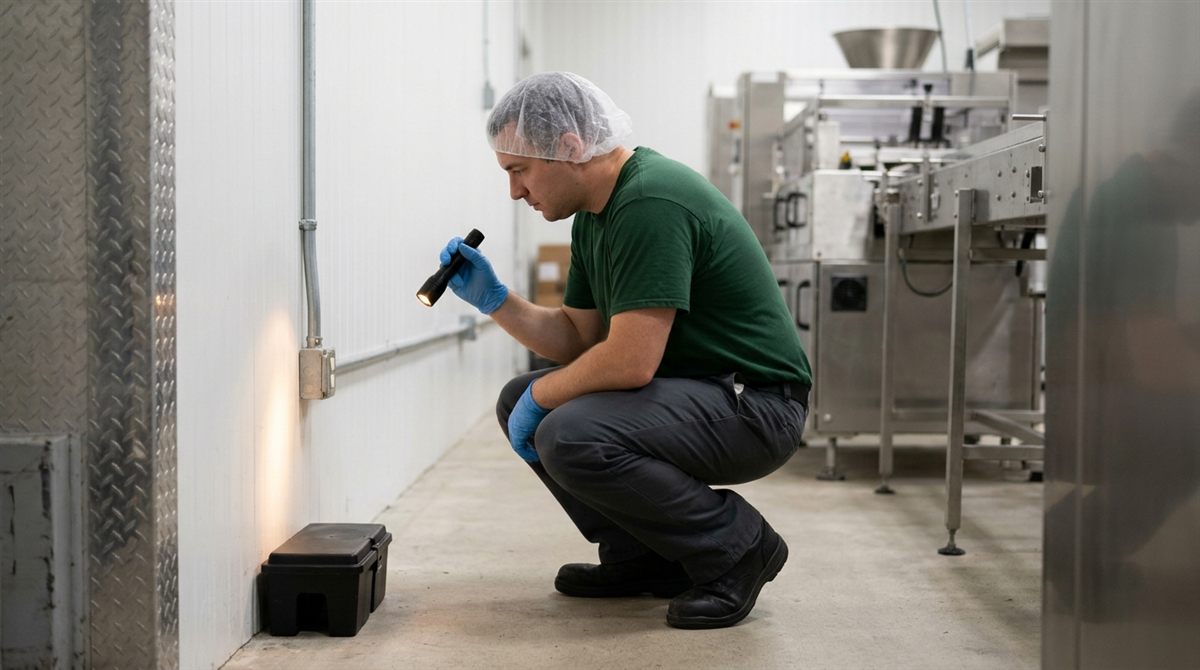

The line read “Recommend sealing conduit penetration, east wall”, and it had gone out in three service reports in a row. Each Tuesday, the trap behind the bakery’s packaging line 2 had held a mouse. The night shift had even written one up on the bakery’s pest sighting log, the sheet where staff note any pest they see, at twenty to midnight on a Monday. Renee, who owns the pest control company, had read every report before it went out. She thought the problem had been handed over.
Her company has three technicians and serves bakeries and two food warehouses within an hour of its yard. The bread bakery is its biggest account, about a third of the work. Renee is not a real person. She, the bakery and its record are an example built for this guide.
Four mice, and nobody asked to fix the hole
Joanne, the bakery’s QA manager, who keeps its food-safety paperwork, called Renee at nine on the morning of the fourth Tuesday. One of the bakery’s customers was sending an auditor in a little over two weeks, and Joanne had been going through her file. “He’s going to ask what was done about that mouse,” she said. “What do I tell him?”
Renee pulled the three reports. Each said the same thing, in the same words, to the same inbox. None said who should seal the gap, or by when, or when anyone would look again. Before noon her technician called from the line: a fourth mouse in the same trap, and the gap just as it had been.
Renee called the bakery’s maintenance lead next. Ray had worked there eleven years and knew every wall in the building. “Nobody told me about any conduit,” he said. He wasn’t being difficult. Joanne filed pest reports in a food-safety folder, and Ray’s crew took its jobs from work orders. Three Tuesdays of “recommend” had reached nobody with a drill.
Whose job the hole was
The FDA’s rule for US food plants, 21 CFR 117.35, settled that. It puts the job of keeping pests out, and of keeping the building in repair, on the bakery. So a hole in the bakery’s wall was Ray’s to close and Joanne’s to answer for, whoever had found it. The rule never told Joanne to keep a pest record or hire a pest company. The record was simply how she would show an auditor that the job was being done.
Renee’s mistake was plain once she saw it. “Recommend sealing” was addressed to everyone, so it was nobody’s job. One state agency’s pest contract puts the company’s part in a single sentence: it “must inform” the kitchen’s manager of “sanitation or structural conditions found.” Renee’s reports had informed an inbox, not a person.
That evening she wrote a new rule for her three technicians. Every problem they found on a visit would be written up as a finding, with the name of the one person responsible for fixing it and a date beside it. That person would hear in writing the same day, with the date of the next check. And no finding would be signed off until the repair was done and the traps had stayed empty on the next two weekly visits. On the first of those visits, the technician would look at the repair himself.
At the wall behind packaging line 2
On Wednesday morning Renee met Joanne and Ray behind the line. The gap was about four inches across, where the conduit entered the east wall two feet above the floor. Joanne looked at it for a long moment. “Four mice in packaging,” she said, “and this has been in the reports since the sixth?” She had filed every one of those reports herself, and she knew it. Then she turned to Renee. “You saw it three times and sent me a sentence.”
Ray crouched, looked, and asked the obvious question. “Can’t your guy just foam it?”
“The hairline cracks along the base, yes,” Renee said. “That’s small sealing, it’s in our agreement, and he’ll do them before we leave. A four-inch hole with live wires running through it is your wall, Ray.” Her agreement drew the same line as one university’s pest contract. There, the company “is not responsible for carrying out structural modifications” but does the “minor applications of caulk, expanding foam, and other sealing materials.” Her technician sealed the cracks while they talked and set a second, temporary trap four feet away.
Ray groaned. He had an oven down and a line to keep running, and Friday was the soonest he could get to it. Then he raised a work order on his phone and read the number out, and Renee put it in the record beside the mouse. By the time she reached her truck, Joanne and Ray each had an email with the photo, the work order and the date of the next check.
Joanne wanted more. “Can we call it done once Ray’s sealed it?” Renee said no. A sealed hole was the fix, not the proof. The proof would be two Tuesdays with nothing in either trap. Joanne counted on her fingers. “That’s the tenth. The auditor’s in on the twelfth.” It was close, and Renee didn’t promise anything.
Two empty Tuesdays and nothing new on the pest sighting log
Ray’s crew sealed the conduit on Friday afternoon and sent a photo. On Tuesday the technician took his own photo of the seal, still flush, and found both traps empty. The next Tuesday they were empty again, and nobody on the night shift had added a line to the log. Renee signed the finding off that afternoon. The temporary trap came off the wall, and the device map, the plan of where every trap sits, was redrawn so the next technician wouldn’t hunt for a trap that wasn’t there.
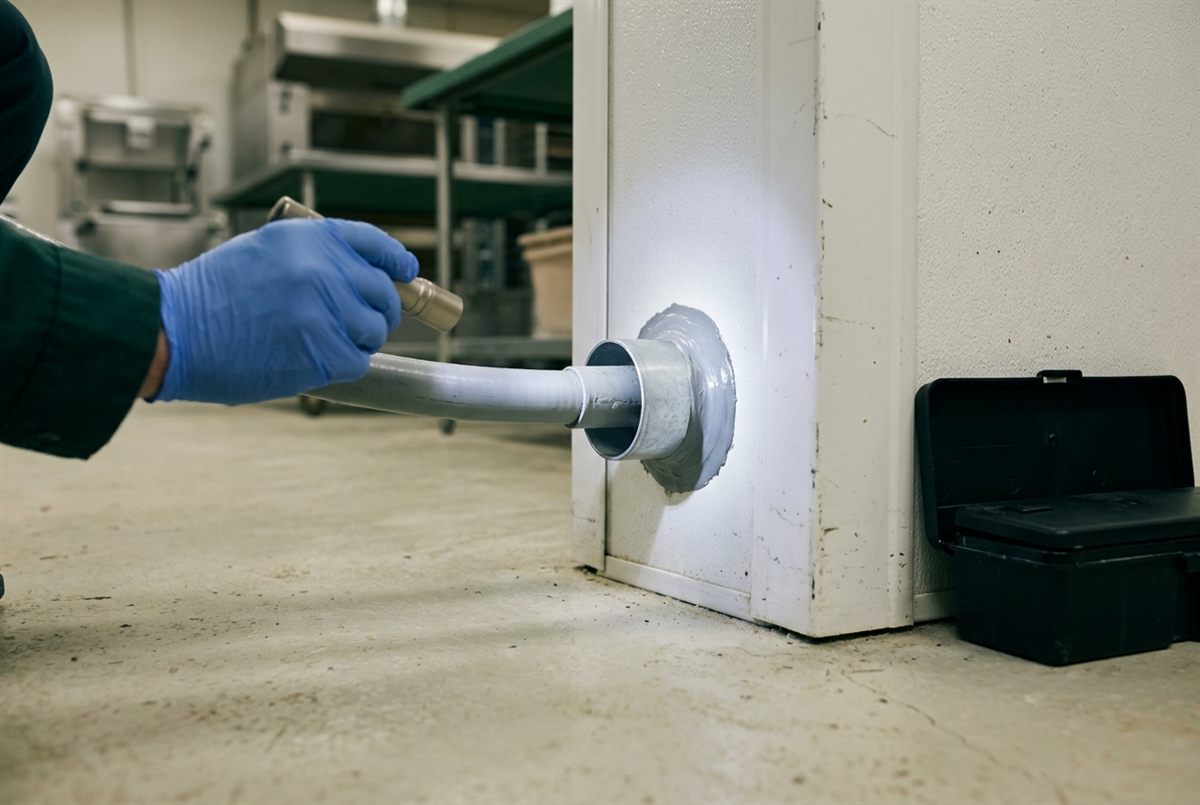
Two days later Joanne opened the record for the auditor: five weeks, four mice, one work order.
| Field | Entry (example) |
|---|---|
| Finding | F-2026-1006-02: mice at packaging line 2, east wall |
| First seen | Tue Oct 6, weekly service: trap IT-31 behind packaging line 2, 1 house mouse (device map version 6) |
| How the mice get in | Gap about 4 in. around the electrical conduit entering the east wall, 2 ft above the floor; photos 1–2 |
| Activity level | High (the company’s own rule for packaging areas: any mouse counts as high) |
| Oct 13 and Oct 20 services | IT-31, 1 house mouse each time; the report says “recommend sealing” again, with no name and no date |
| Bakery’s pest sighting log | Mon Oct 19, 11:40 p.m., night shift: mouse along the east wall behind packaging line 2 |
| Oct 27 service | IT-31, 1 house mouse (the fourth); gap unchanged; the maintenance lead hears of it by phone |
| Person responsible | Wed Oct 28: the bakery’s maintenance lead raises work order WO-55821 (wall work) |
| Pest company’s own work | Oct 28: cracks along the wall base sealed (small sealing, in the agreement); temporary trap IT-31T 4 ft south, map version 6a |
| Written notice | Oct 28, email to the QA manager and the maintenance lead: photo, work order, date of next check |
| Bakery’s repair | Fri Oct 30: conduit sealed by the bakery’s maintenance crew; their photo |
| Check 1 | Tue Nov 3: IT-31 and IT-31T empty; seal in place, photo 3 |
| Check 2 | Tue Nov 10: IT-31 and IT-31T empty; nothing new on the sighting log |
| Signed off | Nov 10, by Renee: repair in, then two empty weekly checks, the seal seen at the first (the company’s own rule); IT-31T removed; map version 7 |
| Days before anyone was responsible for the fix, Oct 6 to Oct 28 | 22 |
| Days from the first mouse to the last check, Oct 6 to Nov 10 | 35 |
What the auditor wrote down
The auditor worked from AIB International’s inspection standards, the ones the bakery’s customer asks for. They ask for every problem raised in a service report or a pest sighting log to be fixed and “documented as complete”, so he went straight to the last rows. He circled the twenty-two days before anyone was responsible for the gap and asked Joanne about them. The number went into his report as one line. Joanne passed that on to Renee the same evening, without softening it.
The twenty-two days were not the only cost. In the two weeks before the audit, Renee had spent two evenings going through every open problem in her reports, across all her accounts. She found fourteen on six sites with nobody’s name on them. Two were jobs for her own company: a cracked lid on a bait station at a warehouse, and a trap map a version out of date.
She changed her report form too. One of her bakery clients is audited to SQF, another food-safety standard, and its new edition for food manufacturers says the pest company must provide “a written report of their findings.” So her form now gave every problem its own written line, ending with who fixed it and when.
The week the auditor came, every open problem in Renee’s reports carried one name and the date of its next check, and the hole behind packaging line 2 carried the day Ray sealed it.
The short answer: When a mouse goes on the pest sighting log, ask one named person on your client’s staff to fix the gap it came through. Put it in writing that day, with the date you will check again. Call it fixed only after the repair and two weekly checks with no mice. This week, put a name beside every open problem.
FOUR MICE, ONE WORK ORDER
A repair isn’t the end. The traps have to stay empty after it.
The hole behind packaging line 2 counted as fixed only after Ray’s seal had held through two empty Tuesdays. Pesvaro was built to follow every finding from the fix to the checks that prove it.
Sources and references
- U.S. Food and Drug Administration, 21 CFR 117.35, “Sanitary operations”, paragraphs (a) and (c), eCFR, read November 13, 2026. ecfr.gov
- State of Hawaii, Department of Corrections and Rehabilitation, Invitation for Bid B26002003, Attachment A, Amendment 2 (March 10, 2026), clause 1.e.4.a; one buyer’s terms, read November 13, 2026. hiepro.ehawaii.gov
- University of South Carolina, IFB USC-IFB-3343-KS, “Integrated Pest Control Services for the Department of Housing Buildings” (September 21, 2018), clause 12.6; one buyer’s terms, read November 13, 2026. sc.edu
- AIB International, “The AIB International Consolidated Standards for Inspection”, 2022 edition (the edition used for inspections through December 31, 2026), section 5.5, Integrated Pest Management (IPM) Program (copy hosted by AFDO), read November 13, 2026. afdo.org
- AIB International, “AIB International Releases 2027 Consolidated Standards…”, news release, July 14, 2026 (inspections under the 2027 edition from January 1, 2027), read November 13, 2026. aibinternational.com
- SQFI, “Food Manufacturing Edition 10 Checklist”, element 11.2.4.2 (vii), and “Edition 10 FAQ” (audits not before January 2, 2027), read November 13, 2026. sqfi.com checklist · sqfi.com FAQ